Milan Kosar was an artist and graphic designer who lived and worked the majority of his career in Chicago, Illinois. He was born in 1931, in Prague, of the Czech Republic. He studied at the Graphic School in Prague, and received his university equivalent Diploma of Excellence in Drawing and Graphic Arts in 1949. He completed additional graduate studies in art history, Russian language and the social sciences by 1956.
Afterward, Kosar migrated to the United States (Chicago). For the next thirty years, he worked as a graphic designer, but he continued to paint various subjects throughout the rest of his life. The range of his stylistic approach and technical prowess shows a mastery of medium but what comes through most evidently is his love of life and all the adventures it has to offer.
Kosar painted almost exclusively on illustration board. His smaller, portable watercolors on paper show his ever-curious eye as he takes the viewer with him on his travels abroad, weekend excursions to the beach, walks in the park, or quietly shares his time at home with the family. Each of these subjects has a nostalgic aura about them. The openness of these compositions is reminiscent of Edward Hopper’s spare subjects, but the colorful nature of Kosar’s landscapes reminds us of the work of the Expressionist Edvard Munch.
To show the breadth of the Kosar exhibition it has been divided into three areas: portraits, landscapes, and abstractions.
His portraits show a love of the face and they portray a gentleness with regard to the family scenes. Kosar tended to start off these pictures as sketches while observing the family unit, or having worked from a photographic reference. Still, there is something endearing and sweet about how he has the characters interact with one another. Later on, Kosar would sometimes re-paint these subjects in different color schemes, or move up in scale onto illustration board. He did work in series of familial subjects. These tend to be quite beautifully layered in translucent color; the air fragrant with life.

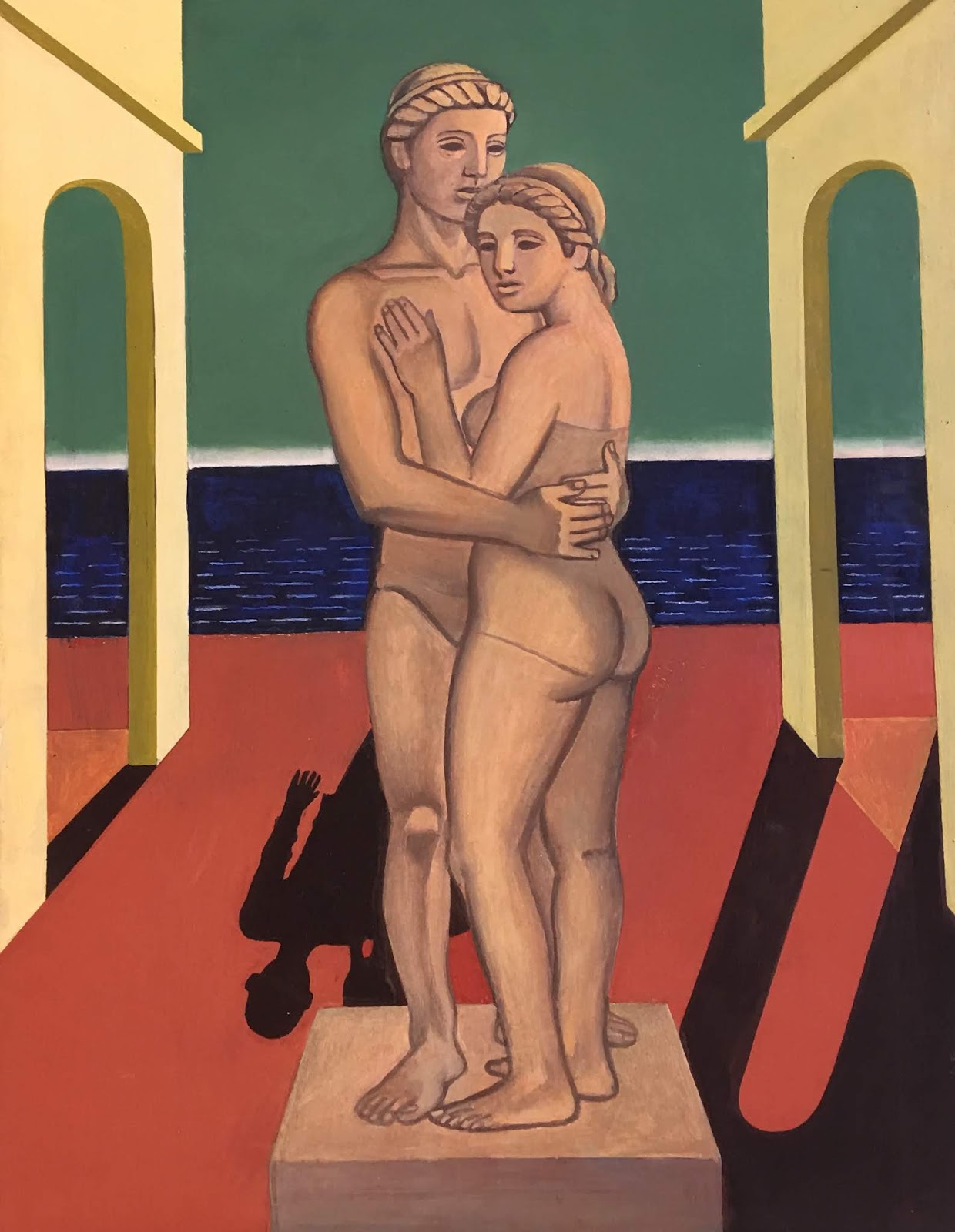
A closer examination of Kosar’s portraits shows his love of the face and how he conveys his love for the subject. There are a few dual portraits, or rather a couple engaged in a gentle embrace in one scene, then the same couple is modeled as nude statues in a landscape similar to the work of di Chirico. The next time we see the same couple they have been upgraded to 60s attire and are engaged in a kooky beatnik, colorful wide-eyed embrace.
The next section of the exhibition shows Kosar’s interest in travel abroad in Paris and in various cities, including Chicago. His drawing skills show his mastery of vanishing point perspective, and he clearly kept challenging himself to draw architecture, CTA train lines and Lake Shore Drive. These works seem more subdued color-wise than the rest of the exhibition, but one could understand the the analytical nature of the works were more important than color.

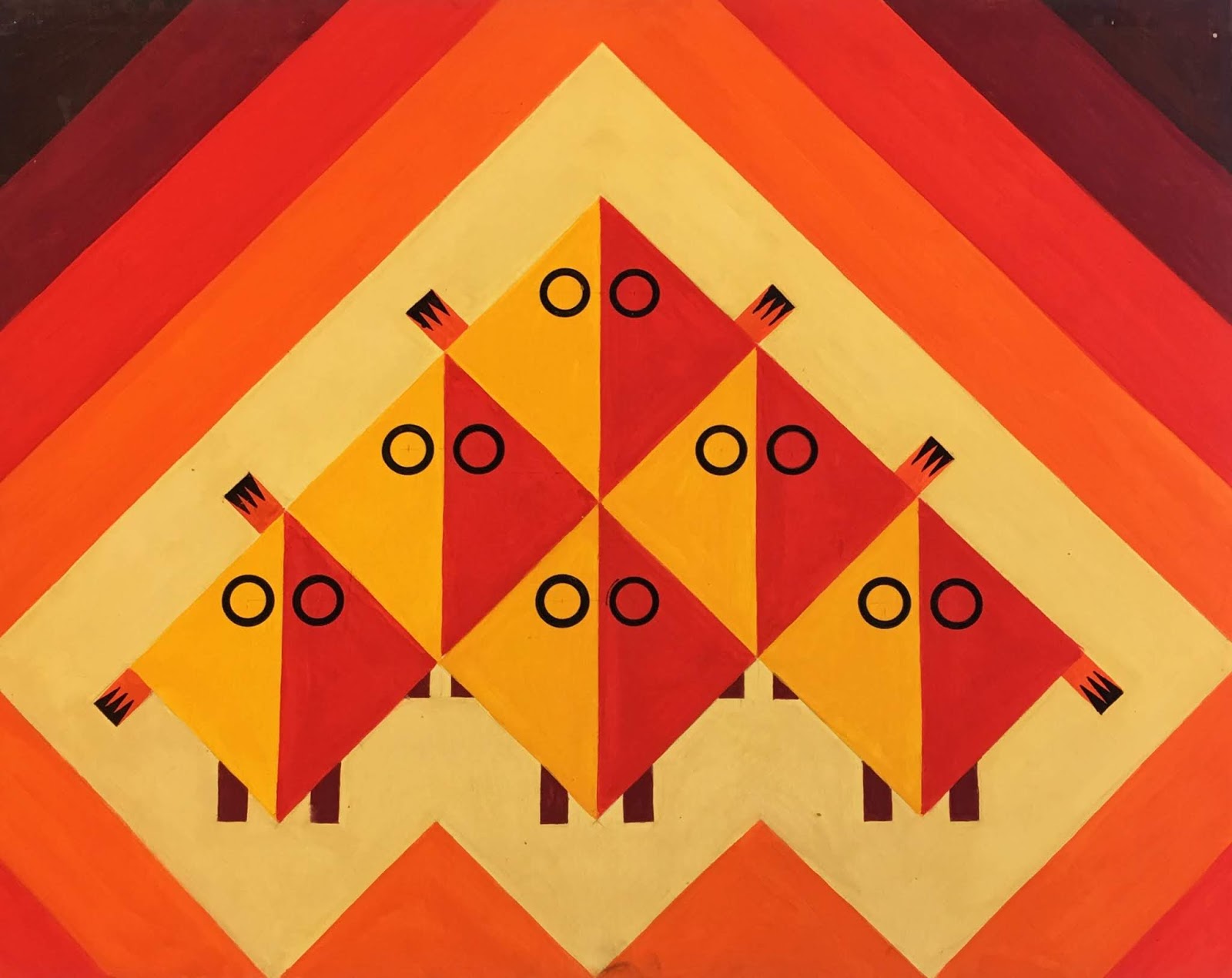
Abstraction is a large part of Kosar’s body of artwork as well. He painted them throughout his career, but as he got older, he spent more and more time painting abstractions of color optics, and balanced compositions. This subject seems to be most important toward the end of his career, especially after the event of 9/11 in New York City in 2001. The earlier abstract compositions have balance and color, but they appear as if he is working out compositional exercises for himself. The latter abstract works feel different, more personal, as if he is trying to make sense of a world gone mad. They change in their balance, and directionally have less order about them. His commentary here was that the world was losing its moral compass.

Overall, the body of this artist’s work shows he was a person always searching for life and love. While Kosar never exhibited his artwork during his lifetime, these works, which are now a part of the Benedictine University’s permanent collection, will always be available for students, and the public to see and appreciate. The exhibition will run through February 28th.