Saturday, April 22, 2017

BenU Student Annual Exhibit Opens at the Komechak

On April 19, 2017, the first BenU Student Annual Art Exhibit opened at the Komechak Art Gallery, at Benedictine University. In it, were 152 pieces of artwork produced by the students in the university's Communications, Fine Arts and Graphic Arts programs. This celebrates the first exhibit of its kind at the Komechak Art Gallery. Student art displays are common on the BenU Lisle campus, but this is the first time that the combined works of three programs have been shown collectively, and in the Komechak Art Gallery.
Students were encouraged to enter three pieces of their choosing, from the fall through spring semester of the 2016-2017 academic year. Areas that were represented included drawing, communications, graphic design, painting, printmaking, calligraphy, 3D design, photography and mixed media.
At the close of the exhibit, five artists will receive a People's Choice Award, which were voted on throughout the time of the exhibit. This will become an annual competition showcasing the artwork produced at BenU. The exhibit runs through April 29th, 2017. www.ben.edu/artgallery Many thanks to Ms. Beatrice Turner for her installation assistance, and thanks to Mrs. Gathaleen Gaddis for her work on the handouts, reception and publicity. Thanks also to the following instructors who help gather works for the show: William Scarlato, Luigi Manca, HaiRi Han, David Marcet, Jennifer Scavone, Stacy Jo Barber, Vincent Lucarelli and Lynn MacKenzie. Below are some more pictures from the April 19th opening reception:

Thursday, March 9, 2017

Jake Fernandez and his Reconstructed Collages of Nature

Artist Jake Fernandez left Cuba in 1961 and came to live in the United States. He and his family settled in Florida and he later attended the University of South Florida. Living in the tropical state Fernandez came to study and appreciate the beauty of Nature. He often took photographs of the parks and green spaces. That practice continued through his career as he documented his travels throughout the United States - New York, California, Florida and Indiana and Illinois. He amassed thousands of photographs and one day started to cut them up to make collages of those images.
The multiple views look he created from these photographs was very like the method of multiple perspectives created by David Hockney's photo collages. However, Fernandez took his collages a step further....the result after thirty years of making collages, is a wonderful exhibition of small works currently showing at the Komechak Art Gallery at Benedictine University. It is called "Second Nature".
Fernandez doesn't just cut up his photographs, he makes uniquely organic cut shapes and splinters the fragmented images into a million tiny, microscopic pieces. The scale of the images is square or rectangular. They are surely larger than the original photographs, but his incinerated cut shapes fracture into countless tiny pieces that when he glues them back together, they become a mosaic, a jeweled surface that stuns the viewer into a mesmerizing silence. The viewer is engaged to come close to see how Fernandez takes apart and then reconstructs a place of natural beauty.
The infinite layering that ultimately becomes a newly re-defined place in Nature, makes us contemplate Fernandez' technique, but moreso makes us see his natural places of wonder in a whole new way. They are definitely abstracted from the original source of reference, but they take on a cosmic type of existentialism. His works refer to the wonder of seeing a Jackson Pollock drip painting, or the elegant simplicity of a Rothko, but Fernandez' works are so densely built up in tecture and surface that we are pulled in to look at the collages literally examining singly cut pieces. The result is a type of Zen experience, where the viewer has reached a heightened awareness of beauty and destruction and resurrection.
One cannot help but take away an impression of obsessive searching, relentless pursuit for the 'Truth'. These are incredible works by an artist clearly at the top of his game.
Fernandez also makes paintings and drawings - large scale - of the same subjects. His mastery of the pencil and the brush is evident in his brushwork and his search for shape, light and depth of mysterious spaces. His work truly reflects his love of subject, and he is a man on a mission to make a new chapter into the art history books about landscape painting, drawing and collage.
The exhibition runs from March 6 to April 15, 2017. For more information about the artist and his work go to http://www.jakefernandez.com

Saturday, January 7, 2017

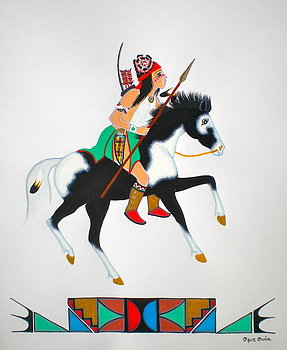
"Contemporary Art Warriors" Comes to Komechak Art Gallery

Komechak Art Gallery welcomes in 2017 with an exhibition of Native American artists and also Native American veteran artists from the Trickster Gallery of Schaumburg, Illinois. Joseph Podlasek, CEO and owner of Trickster coordinated the exhibit which features 20 works by eight nationally recognized artists. This article will give you some information about the artists participating in the exhibit. The show runs January 17 through February 28. A reception for the public and the artists will take place at Komechak Art Gallery on Wednesday, January 25th, from 3:00 - 6:00 p.m. Admission is Free. Refreshments will be served.
Jimmy “Two-Dogs” Coplin(1958-2015) His given name was James Andrew Rokita; later in life, Jimmy changed his name to honor his Native American heritage, after learning his father was a member of the Kiowa Tribe. In his early years, Jimmy lived many places around the country because his step-father was in the U.S. Air Force. At age 21, Jimmy joined the United States Army, serving as an infantryman. He went on to a successful career as a transmission mechanic.Jimmy eventually lost his eyesight to diabetes, but that did not stop him from establishing a second career as a renowned Native American artist who specialized in creating artwork with ceramics, silver, feathers and arrows. After living in Arizona, California, Colorado, Kansas, New Mexico and Texas, Jimmy moved to Chicago in an effort to gain more exposure for his art. His work was well-received, and his pieces were featured in exhibits at Trickster Art Gallery, Field Museum, and Chicago Cultural Alliance, and some exhibits still traveling with pictures of his art. Jimmy would often be seen around Chicago and the suburbs with his beloved guide dog and companion, Andy, an energetic German shepherd. Jimmy worked at Edward A Hines Jr. VA Hospital, training medical personnel about Native American cultural traditions. He was also an active member of the Native Veterans of Illinois at Trickster Art Gallery.
Bunky Echo Hawk Echo Hawk is a member of the Pawnee Nation of Oklahoma, and an enrolled member of the Yakama Nation. He attended the Institute of American Indian Arts in the 1990s. He served as the "co-founder and the Executive Director of NVision, a national Native nonprofit that focuses on Native youth development," and he is also a traditional singer and dancer.
Brent Learned Learned is an award winning and collected Native American artist who was born and reared in Oklahoma City, Oklahoma. He is an enrolled member of the Cheyenne-Arapaho Tribes of Oklahoma. Brent graduated from the University of Kansas with a bachelor degree in Fine Arts.He is an artist who draws, paints and sculpts the Native American Indian in a rustic impressionistic style. He has always appreciated the heritage and culture of the American Plains Indian. He tries to create artwork to capture the essence, accuracy and historic authenticity of the American Plains Indian way of life. Although Brent has many different styles, he is typically known for his use of bold vibrant colors in his depictions of the American Plains Indian. Brent’s work resides in museums such as the Smithsonian Institute-National Museum of the American Indian in Washington D.C., the Cheyenne/Arapaho Museum in Clinton, Oklahoma, the National Cowboy and Western Heritage Museum in Oklahoma City and the University of Kansas Art Museum in Lawrence, Kansas. He has work in private collections such as the Governor of Oklahoma Private Collection, Governor’s Mansion in Oklahoma City, the Haskell Indian University in Lawrence, Kansas and the Kerr Foundation Private Collection in Oklahoma City. Brent also has the honor of having one of his paintings displayed in the Democratic National Headquarters in Washington D.C.
George C. Levi Levi is a member of the Southern Cheyenne Tribe of Oklahoma. He is also Southern Arapaho and Oglala Lakota. He was raised in the Western Oklahoma Communities of El Reno, Concho and Geary. The art and history of the Cheyenne people motivate him in his art. He is influenced by the Cheyenne and Arapaho artists of the past. He specializes in Cheyenne style ledger art, and also acrylic and watercolor paintings. He is also well known for his custom beadwork and parfleche work. His artwork is well known and can be found in various museums, art exhibits, galleries, and private collections in the United States and around the world.
Ramos Sanchez Sanchez’s life has taken him from Ildefonso Pueblo to Okinawa, Japan, and back again. He joined the Navy in 1944 at the age of 18 and served during World War II. Later in life Sanchez served at the vice chairman of the All Indian Pueblo Council and began work on various educational boards including the Eight Northern Pueblos’ Council where he helped to recruit minority students into higher education. He retired in 1994 and now spends most of his time producing traditional watercolor paintings under his other name: Oqwa Owin. Horses, wildlife, clowns and dancers are some of the World War II veteran’s favorite subjects. “I’ve been painting my whole life,” Sanchez said. “I could fill a museum.
Robert Wapahi Wapahi’s scratch board drawings reflect his Dakota/Santee heritage. Originally dreaming of a career in music, Wapahi stumbled into the visual art world at the age of thirty-eight, when he received a huge amount of paper and technical pens. At first, he wadded up the large sheets of paper and practiced his jump shots. Then he found the pens, and those few days of scribbling went by so fast that he was hooked. It was easier to carry a pen and paper than a piano or a set of percussion instruments, and for Wapahi that worked out fine. He quickly discovered a talent for drawing and soon found a reason to draw while on a visit to Chicago and the American Indian Center. Since then, he has spent nearly twenty winters creating his art. For eleven winters, he decorated the American Indian Center’s one hundred room building. For the first half of Wapahi’s life, music was his love and it was rare to see him without a pair of drum sticks. For the last half of his life, he expects to carry a small sketchbook and pen.
Joe Yazzie Yazzie is a full-blooded Navajo, born and raised two miles from the Pinedale Trading Post in New Mexico. His parents were both artistic, my mother sculpted with clay and also did weaving. His father was a silversmith and also worked and traveled with the railroad to make a living. He came to Chicago in 1964 on the relocation program and attended and graduated from the Institute of Lettering and Design. After graduating, he decided to serve his country and joined the Army and completed a two year tour of duty in Vietnam and was awarded two Bronze Stars. Upon returning from Vietnam in November 1967, Yazzie decided to go back home to New Mexico, but as he passed the Montgomery Ward building in Chicago, he applied for a job as a commercial artist where he worked for nearly 25 years. Yazzie took art classes at the American Academy of Art in Chicago. Since then he has worked as a Graphic Designer for the Daily Herald Newspaper in Arlington Heights. A lot of his ideas are from what he dreams about the Indian people of the southwest...the Navajos, and some Apaches. His artwork is now displayed at several Chicago art galleries downtown and in the Northwest Suburb area, including at the Trickster Gallery in Schaumburg, IL. His work can be seen at www.yazziegallery.com.

Sunday, November 27, 2016

"Creches III: The Nativity" Comes to Komechak Art Gallery

The Komechak Art Gallery is featuring its third annual holiday exhibition of "Creches III: The Nativity",from November 21 through December 23rd. The public is invited to celebrate the opening reception of the exhibition on Sunday, December 4th, from 2-4:00 p.m.
As in past years, the holiday exhibition features a private collection of creches(nativity scenes). This year's collection comes from the Michael Whalen family, of Detroit, Michigan. Mr. Whalen is the past president of the national organization, Friends of the Creche Society. For more information on the group see www.friendsofthecreche.org
The Whalens have been collecting creches for 60 years, and their collection spans the globe. Komechak Art Gallery is displaying 150 sets of creches from Mr. Whalen's impressive collection.
To give a brief history about the history of the creche see below.... A nativity scene or crèche; also known as a manger scene, or crib, is the special exhibition, particularly during the Christmas season, of art objects representing the scene of the birth of Jesus. While the term "nativity scene" may be used of any representation, it has a more specialized sense referring to seasonal displays, either using model figures in a setting or enactments called "living nativity scenes" in which real humans and animals participate.
A nativity scene takes its inspiration from the accounts of the birth of Jesus in the Gospels of Matthew and Luke. Luke's narrative describes an angel announcing the birth of Jesus to shepherds who then visit the humble site where Jesus is found lying in a manger, a trough for cattle feed.(Luke 2:8-20) Matthew's narrative tells of "wise men" who follow a star to the house where Jesus dwelt, and indicates that the Magi found Jesus some time later, less than two years after his birth, rather than on the exact day.(Mat.2:1-23) Matthew's account does not mention the angels and shepherds, while Luke's narrative is silent on the Magi and the star. The Magi and the angels are often displayed in a nativity scene with the Holy Family and the shepherds although there is no scriptural basis for their presence.(Luke 2:7;2:12;2:17)
St. Francis of Assisi is credited with creating the first nativity scene in 1223 at Greccio, central Italy, in an attempt to place the emphasis of Christmas upon the worship of Christ rather than upon gift giving. The nativity scene created by St. Francis is described by St Bonaventure in his Life of Saint Francis of Assisi written around 1260. Staged in a cave near Greccio, St. Francis' nativity scene was a living one with humans and animals cast in the Biblical roles. Pope Honorius III gave his blessing to the exhibit. Such pantomimes became hugely popular and spread throughout Christendom. Within a hundred years every church in Italy was expected to have a nativity scene at Christmastime. Eventually, statues replaced human and animal participants, and static scenes grew to elaborate affairs with richly robed figurines placed in intricate landscape settings. Charles III, King of the Two Sicilies, collected such elaborate scenes, and his enthusiasm encouraged others to do the same.
The scene's popularity inspired much imitation in Catholic countries, and in the Early modern period sculpted cribs were set up in Catholic churches and homes, often exported from Italy. These elaborate scenes reached their artistic apogee in Papal state, Emilia, Kingdom of Naples, Genoa that had an important tradition, notably those of Anton Maria Maragliano. By the end of the 19th century nativity scenes became popular beyond Catholic settings, and many versions of various sizes and in various materials such as terracotta, paper, wood, wax and ivory were marketed, often with a backdrop setting in the stable.
Different traditions of nativity scenes emerged in different countries. Hand-painted santons are popular in Provence. In southern Germany, Austria and Trentino-Alto Adige the figurines are handcut in wood. Colorful szopka are typical in Poland. A tradition in England, involved baking a mince pie in the shape of a manger to hold the Christ child until dinnertime when the pie was eaten. When the Puritans banned Christmas celebrations in the 17th century, they also passed specific legislation to outlaw such pies, calling them "Idolaterie in crust".
Distinctive nativity scenes and traditions have been created around the world and are displayed during the Christmas season in churches, homes, shopping malls, and other venues, and occasionally on public lands and in public buildings. The Vatican has displayed a scene in St. Peter's Square near its Christmas tree since 1982 and the Pope has for many years blessed the mangers of children assembled in St. Peter's Square for a special ceremony. In the United States, the Metropolitan Museum of Art in New York City annually displays a Neapolitan Baroque nativity scene before a 20 ft. blue spruce.
A static nativity scene may be erected indoors or outdoors during the Christmas season, and is composed of figurines depicting the infant Jesus resting in a manger, Mary, and Joseph. Other figures in the scene may include angels, shepherds, and various animals. The figures may be made of any material, and arranged in a stable or grotto. The Magi may also appear, and are sometimes not placed in the scene until the week following Christmas to account for their travel time to Bethlehem. While most home nativity scenes are packed away at Christmas or shortly thereafter, nativity scenes in churches usually remain on display until the feast of the Baptism of the Lord.
The nativity scene may not accurately reflect gospel events. With no basis in the gospels, for example, the shepherds, the Magi, and the ox and ass may be displayed together at the manger. Some traditions bring other scriptural characters to the nativity scene such as Adam and Eve and the serpent, Noah and his animals, the twelve sons of Jacob, the twelve prophets and the twelve apostles. Mundane activities such as Mary washing diapers in the River Jordan, or a dove descending on the newborn infant may be depicted. The art form can be traced back to eighteenth-century Naples, Italy. Neapolitan nativity scenes do not represent Palestine at the time of Jesus but the life of the Naples of 1700, during the Bourbon period. Families competed with each other to produce the most elegant and elaborate scenes and so, next to the Child Jesus, to the Holy Family and the shepherds, were placed ladies and gentlemen of the nobility, representatives of the bourgeoisie of the time, vendors with their banks and miniatures of cheese, bread, sheep, pigs, ducks or grape, and typical figures of the time like gypsy predicting the future, people playing cards, housewives doing shopping, dogs, cats and chickens.
A donkey and an ox typically appear in nativity scenes. Besides the necessity of animals for a manger, this is an allusion to Isaiah: "the ox knoweth his owner, and the ass his master's crib; but Israel doth not know, my people doth not consider "Isaiah 1:3. The Gospels do not mention an ox and donkey. Another source for the tradition may be the extracanonical text, the Gospel of Pseudo-Matthew of the 7th century. (The translation in this text of Habakkuk 3:2 is not taken from the Septuagint.) Therefore, the animals, the ox and the ass, with him in their midst incessantly adored him. Then was fulfilled that which was said by Habakkuk the prophet, saying, "Between two animals you are made manifest." The ox traditionally represents patience, the nation of Israel, and Old Testament sacrificial worship while the ass represents humility, readiness to serve, and the Gentiles.
Happy Holidays to everyone!

Saturday, November 5, 2016

Student Political Art Display At Ben U

Art students in Benedictine University's 2D Design, Calligraphy and Graphic Design courses were invited by the Political Science department to produce work based upon the theme of the 2016 presidential election. The response was terrific. Please see below some examples of the work that is currently on display in Goodwin Hall, 1st floor, now through November 12. many thanks to the student who participated, Professor Phil Hardy for the opportunity to bring this idea together, plus thanks to Jennifer Zingg, Teresa Parker, HaiRiHan, Karen Brooks.